
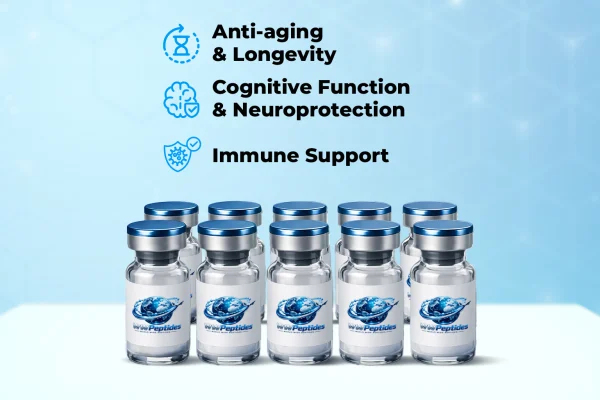
Epithalon
Price range: $108.00 through $333.00
-
Garanzia di consegna Rispedizione gratuita in caso di mancata consegna
-
Purezza ≥99% Produzione diretta dal produttore
-
Certificati di analisi indipendenti Visualizza i COA per questo prodotto →
-
Garanzia di credito negozio Invia qualsiasi risultato COA e ricevi un credito negozio
Epithalon - Ala-Glu-Asp-Gly Tetrapeptide Research Compound
Epithalon (also spelled Epitalon) is a synthetic tetrapeptide with the sequence Ala-Glu-Asp-Gly, developed by Vladimir Khavinson and the St. Petersburg Institute of Bioregulation and Gerontology beginning in the 1980s. It is the short-chain synthetic mimetic of Epithalamin, a pineal-gland extract used in the original Russian longevity research. Epithalon is the most-studied “short bioregulator” in the published literature - a single, well-defined sequence whose research axis sits on telomerase activation, pineal function, and circadian signaling.
Why Telomerase Activation Matters
Telomeres are the repeating DNA caps at the ends of chromosomes that shorten with each cell division. Telomerase is the enzyme that rebuilds them. Khavinson’s group published in-vitro work showing Epithalon upregulates telomerase activity and extends the replicative lifespan of cultured cells. That finding is what places Epithalon in the longevity-research category rather than a nootropic or metabolic category - the downstream endpoints being measured are fundamentally about replicative aging.
| Percorso | In parole povere, ecco cosa fa |
|---|---|
| Telomerase (hTERT) | Upregulated - rebuilds telomere caps on chromosome ends |
| Pineal function / melatonin | Supports endogenous pineal-melatonin rhythm in published rodent work |
| Circadian signaling | Downstream effects on sleep and circadian-gene expression |
| Replicative aging | Extended in-vitro cell-lifespan reported in Khavinson’s published series |
Epithalon vs Epitalon vs Epithalamin
The three names are frequently confused. They describe related but distinct compounds.
| Name | What it is |
|---|---|
| Epithalon / Epitalon | Synthetic Ala-Glu-Asp-Gly tetrapeptide - same molecule, two spellings |
| Epithalamin | Original pineal-extract preparation - a mixture, not a single sequence |
Epithalon is the synthetic short-chain sequence that Khavinson’s group identified as the active component of the Epithalamin extract. “Epitalon” and “Epithalon” are alternate transliterations of the Russian name - there is no chemical difference between the two.
Applicazioni di ricerca
Epithalon is used in studies examining:
- Telomerase (hTERT) activation and telomere-length endpoints
- Replicative cell-lifespan in-vitro
- Pineal function and endogenous melatonin rhythm
- Circadian-gene expression models
- Longevity and age-related gene-expression endpoints
- Comparative bioregulator research (vs Pinealon, Thymalin)
Specifiche tecniche
| Formato | Polvere liofilizzata |
| Purezza | ≥99% |
| Alias | Epitalon, Ala-Glu-Asp-Gly, pineal tetrapeptide |
| Taglie disponibili | 10 mg · 50 mg |
| Archiviazione | 2-8 °C se non aperto; stabile per oltre 12 mesi |
| Utilizzo | Research purposes only - not for human use |
Storage & Handling
Unopened vials are kept at 2-8°C under standard cold-chain conditions and remain stable for 12+ months. Reconstitution parameters, solvent compatibility, and post-reconstitution stability for Epithalon are documented in the published peer-reviewed literature and standard peptide-chemistry references.
Reference Literature
Published clinical and preclinical Epithalon literature is available through PubMed, Google Scholar, and other peer-reviewed databases. WWP does not provide protocol design, dosing guidance, or administration parameters. Those decisions rest with the researcher and any applicable institutional review board.
Common Questions About Epithalon Research
What is Epithalon used for in research?
Epithalon is studied primarily on the longevity axis. Published work covers telomerase (hTERT) activation, telomere-length maintenance, pineal function and melatonin rhythm, circadian signaling, and age-related gene expression. It is the most-cited compound in the “short bioregulator” research category.
What is the difference between Epitalon and Epithalon?
There is no chemical difference. Both names describe the synthetic Ala-Glu-Asp-Gly tetrapeptide. “Epitalon” is closer to the Russian transliteration; “Epithalon” is the Anglicized spelling. Research papers use both interchangeably.
Is Epithalon the same as Epithalamin?
No. Epithalamin is the original pineal-gland extract (a mixture of peptides). Epithalon is the synthetic tetrapeptide that Khavinson’s group identified as the active short-chain component. They are not interchangeable - Epithalon has a defined single sequence; Epithalamin does not.
Is Epithalon FDA approved?
No. Epithalon is not FDA approved in the United States. It was studied and used clinically in Russia but has never been submitted for US regulatory review. Every vial WWP ships is labeled and sold strictly for laboratory and research use only.
How is Epithalon stored?
Le fiale non aperte vanno conservate a una temperatura compresa tra 2 e 8 °C e mantengono la loro stabilità per oltre 12 mesi. Una volta ricostituita con acqua batteriostatica, la soluzione va conservata a una temperatura compresa tra 2 e 8 °C e utilizzata entro 28-30 giorni.
Garanzia di purezza
Ogni lotto ha una purezza pari o superiore al 99%. Inviateci un certificato di analisi (COA) redatto da un ente indipendente e vi accrediteremo un buono acquisto indipendentemente dai risultati riportati.
-

Glutatione
$204.00 Seleziona le opzioni Questo prodotto è disponibile in diverse varianti. Le opzioni possono essere selezionate nella pagina del prodotto -

LL-37
$218.00 Seleziona le opzioni Questo prodotto è disponibile in diverse varianti. Le opzioni possono essere selezionate nella pagina del prodotto -

KPV
Price range: $94.00 through $146.00 Seleziona le opzioni Questo prodotto è disponibile in diverse varianti. Le opzioni possono essere selezionate nella pagina del prodotto -

Selank
Price range: $87.00 through $209.00 Seleziona le opzioni Questo prodotto è disponibile in diverse varianti. Le opzioni possono essere selezionate nella pagina del prodotto