
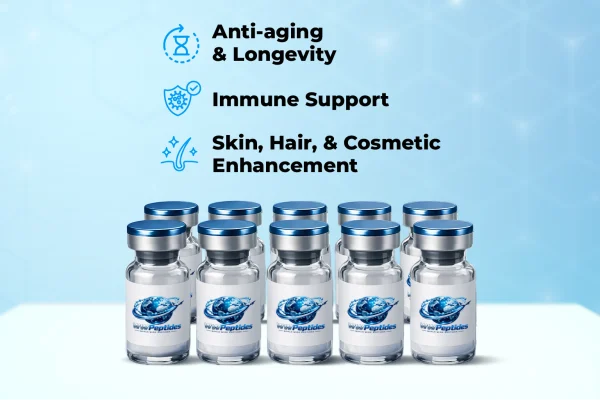
Glutatione
$204.00
-
Garanzia di consegna Rispedizione gratuita in caso di mancata consegna
-
Purezza ≥99% Produzione diretta dal produttore
-
Certificati di analisi indipendenti Visualizza i COA per questo prodotto →
-
Garanzia di credito negozio Invia qualsiasi risultato COA e ricevi un credito negozio
Glutathione - Reduced L-Glutathione (GSH) Research Compound
Glutathione (GSH) is a tripeptide of glutamate, cysteine, and glycine - the most abundant endogenous antioxidant in mammalian cells. It is the master thiol in the body’s redox system and sits at the center of detoxification, oxidative-stress buffering, and mitochondrial function. In the research-peptide toolkit, reduced L-glutathione is the reference antioxidant compound: it is what other antioxidants are measured against, and its cellular concentration is the standard readout for “redox status” in oxidative-stress research.
Why the Reduced (GSH) Form Matters
Glutathione cycles between two forms: reduced (GSH, active) and oxidized (GSSG, inactive). The GSH:GSSG ratio is the most-cited single indicator of cellular redox state in the published literature. When researchers supply exogenous glutathione, the reduced form is what matters - GSSG cannot accept additional electrons until it is recycled. The research interest is in supplying the active form directly so that downstream antioxidant enzymes (glutathione peroxidase, glutathione-S-transferase) can continue running without being substrate-limited.
| Percorso | In parole povere, ecco cosa fa |
|---|---|
| GSH:GSSG ratio | Restored - the core readout of cellular redox status |
| Glutathione peroxidase | Substrate-fed - neutralizes peroxides and lipid hydroperoxides |
| Phase II liver detoxification | Supports glutathione-S-transferase conjugation of xenobiotics |
| Mitochondrial redox | Buffers ROS generated during oxidative phosphorylation |
| Tyrosinase / melanogenesis | Downregulated - shifts melanin synthesis toward pheomelanin in dermatology research |
Applicazioni di ricerca
Glutathione is used in studies examining:
- Cellular redox balance and GSH:GSSG ratio endpoints
- Liver detoxification and Phase II conjugation research
- Mitochondrial oxidative-stress models
- Neurological oxidative-stress endpoints (Parkinson’s, ALS models)
- Dermatology research - tyrosinase inhibition and pigmentation endpoints
- Paired antioxidant research (with vitamin C, alpha-lipoic acid, NAC)
Specifiche tecniche
| Formato | Polvere liofilizzata |
| Purezza | ≥99% |
| Alias | GSH, reduced L-glutathione, gamma-glutamyl-cysteinyl-glycine |
| Taglie disponibili | 1500mg |
| Archiviazione | 2-8 °C se non aperto; stabile per oltre 12 mesi |
| Utilizzo | Research purposes only - not for human use |
Storage & Handling
Unopened vials are kept at 2-8°C under standard cold-chain conditions and remain stable for 12+ months. Reconstitution parameters, solvent compatibility, and post-reconstitution stability for Glutathione are documented in the published peer-reviewed literature and standard peptide-chemistry references.
Reference Literature
Published clinical and preclinical Glutathione literature is available through PubMed, Google Scholar, and other peer-reviewed databases. WWP does not provide protocol design, dosing guidance, or administration parameters. Those decisions rest with the researcher and any applicable institutional review board.
Common Questions About Glutathione Research
What is glutathione used for in research?
It is studied primarily as the reference endogenous antioxidant. Published work covers redox-balance endpoints (GSH:GSSG ratio), liver Phase II detoxification, mitochondrial oxidative-stress buffering, neurological oxidative-stress models, and dermatological pigmentation research via its tyrosinase-inhibition signal.
What is the difference between GSH and GSSG?
GSH is the reduced (active) form of glutathione. GSSG is the oxidized (inactive) form - two GSH molecules linked by a disulfide bridge. The GSH:GSSG ratio is the single most-cited indicator of cellular redox status. Only the GSH form can donate electrons to neutralize reactive oxygen species, which is why research-grade glutathione is supplied in the reduced form.
How is glutathione delivered in research protocols?
Oral glutathione is poorly bioavailable because it is hydrolyzed by gut peptidases. Published research protocols use intravenous, subcutaneous, or intramuscular administration to bypass first-pass breakdown. Liposomal oral formulations are a separate research category with different pharmacokinetics.
Is glutathione FDA approved?
Reduced L-glutathione is listed in the USP and appears as a component in some compounded and intravenous preparations, but injectable glutathione is not FDA approved as a standalone drug. Every vial WWP ships is labeled and sold strictly for laboratory and research use only.
How is glutathione stored?
Unopened vials are stored at 2-8°C and stay stable for 12+ months. Glutathione in solution is more sensitive to oxidation than most peptides - keep reconstituted solution at 2-8°C, protect from light, and use within 14-21 days.
Garanzia di purezza
Ogni lotto ha una purezza pari o superiore al 99%. Inviateci un certificato di analisi (COA) redatto da un ente indipendente e vi accrediteremo un buono acquisto indipendentemente dai risultati riportati.
-
Melanotan 1
$108.00 Seleziona le opzioni Questo prodotto è disponibile in diverse varianti. Le opzioni possono essere selezionate nella pagina del prodotto -
GHK-Cu
Price range: $86.00 through $144.00 Seleziona le opzioni Questo prodotto è disponibile in diverse varianti. Le opzioni possono essere selezionate nella pagina del prodotto -
Epithalon
Price range: $108.00 through $333.00 Seleziona le opzioni Questo prodotto è disponibile in diverse varianti. Le opzioni possono essere selezionate nella pagina del prodotto -

LL-37
$218.00 Seleziona le opzioni Questo prodotto è disponibile in diverse varianti. Le opzioni possono essere selezionate nella pagina del prodotto