
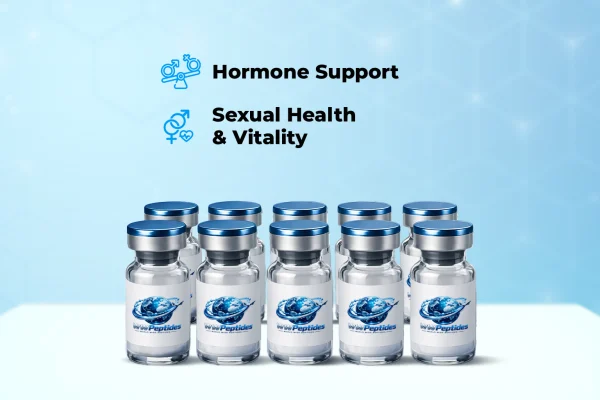
Kisspeptin-10
Rango de precios: $126.00 a $176.00
Los lotes de Envío directo internacional no se someten a pruebas de terceros antes del despacho. Las pruebas independientes son responsabilidad del cliente. Envíanos cualquier COA y recibe $300 en crédito de tienda. Pedidos del almacén de EE. UU.: hay un COA disponible a solicitud. Envíanos cualquier COA independiente y recibe $300 en crédito de tienda.
-
Garantía de entrega Reenvío gratis si no llega. Excluye Canadá, Brasil y Singapur.
-
Especificación de pureza ≥99% Especificación del fabricante - verificable de forma independiente
-
COA independientes Ver los COA de este producto →
-
Garantía de crédito de tienda Envía cualquier resultado de COA y recibe crédito de tienda
Kisspeptin-10 - Compuesto de investigación decapéptido KISS1 C-terminal
Kisspeptin-10 es el fragmento C-terminal de 10 aminoácidos de la proteína KISS1, identificado primero como supresor de metástasis antes de que se describiera su papel en la cima del eje hipotálamo-hipófisis-gónadas (HPG). La proteína KISS1 completa se escinde en fragmentos activos más pequeños (KP-54, KP-14, KP-13, KP-10) - todos señalizan a través del mismo receptor KISS1R (GPR54), pero KP-10 es el fragmento completamente activo más corto y la secuencia de investigación más estudiada. Se ubica por encima de GnRH en el eje reproductivo, por eso es el compuesto de referencia en la investigación sobre la regulación del eje HPG.
Por qué importa la posición de KISS1R en la cima del eje HPG
GnRH es el “maestro” tradicional de la cascada de hormonas reproductivas. Kisspeptin se ubica un nivel más arriba - las neuronas de kisspeptin en el hipotálamo arcuato y preóptico se proyectan directamente sobre las neuronas de GnRH e impulsan el inicio del pulso de GnRH. Esa posición es lo que distingue la investigación con KP-10 de la investigación con análogos de GnRH: KP-10 desencadena el propio pulso nativo de GnRH del cuerpo en lugar de evitarlo. La literatura publicada usa esa propiedad para estudiar la generación del pulso en sí, no solo la producción posterior de LH/FSH/testosterona.
| Vía | Qué hace, en términos simples |
|---|---|
| KISS1R (GPR54) | Agonizado - activa las neuronas de kisspeptina que proyectan hacia las células GnRH |
| Pulso de GnRH | Desencadenada - liberación hipotalámica nativa de GnRH, sin eludirla |
| LH / FSH | Pulso posterior desde la hipófisis |
| Testosterona / estradiol | Respuesta de esteroidogénesis gonadal al pulso de LH |
Kisspeptin-10 vs análogos de GnRH
Kisspeptin-10 y los análogos de GnRH elevan LH y testosterona en los trabajos publicados, pero actúan en puntos distintos del eje.
| Compuesto | Nivel del eje | Qué activa |
|---|---|---|
| Kisspeptin-10 | Por encima de GnRH | Pulso nativo de GnRH desde el hipotálamo |
| GnRH / gonadorelin | Receptor de GnRH | Liberación hipofisaria directa de LH/FSH |
| hCG | Receptor de LH | Esteroidogénesis gonadal directa (omite el hipotálamo y la hipófisis) |
Aplicaciones de investigación
Kisspeptin-10 se utiliza en estudios que examinan:
- Regulación del eje HPG y generación de pulsos nativos de GnRH
- Criterios de valoración de pulsatilidad de LH / FSH y esteroidogénesis posterior
- Investigación en endocrinología reproductiva (modelos de hipogonadismo hipogonadotrópico)
- Investigación genética sobre el inicio de la pubertad y el síndrome de Kallmann
- Investigación comparativa frente a agonistas de GnRH y hCG
- Neuroendocrinología reproductiva - neuronas KNDy del núcleo arcuato
Especificaciones
| Formato | Polvo liofilizado |
| Pureza | ≥99% (especificación del fabricante) |
| Alias | KP-10, metastina (45-54), KISS1 (112-121) |
| Tamaños disponibles | 5mg · 10mg |
| Almacenamiento | 2-8°C sin abrir; estable 12+ meses |
| Uso | Solo para fines de investigación - no para uso humano |
Almacenamiento y manejo
Los viales sin abrir se mantienen a 2-8°C en condiciones estándar de cadena de frío y permanecen estables por 12+ meses. Los parámetros de reconstitución, la compatibilidad de solventes y la estabilidad posterior a la reconstitución de Kisspeptin-10 están documentados en la literatura publicada revisada por pares y en las referencias estándar de química de péptidos.
Literatura de referencia
La literatura clínica y preclínica publicada sobre Kisspeptin-10 está disponible en PubMed, Google Scholar y otras bases de datos revisadas por pares. WWP no proporciona diseño de protocolos, orientación de dosificación ni parámetros de administración. Esas decisiones corresponden al investigador y a cualquier comité de revisión institucional aplicable.
Preguntas frecuentes sobre la investigación con Kisspeptin-10
¿Para qué se usa Kisspeptin-10 en investigación?
Se estudia como el regulador maestro del eje HPG. Los trabajos publicados abarcan la generación de pulsos de GnRH nativa, criterios de valoración posteriores de LH/FSH/testosterona, modelos de hipogonadismo hipogonadotrópico y síndrome de Kallmann, e investigación comparativa con análogos de GnRH y hCG.
¿Cuál es la diferencia entre Kisspeptin-10 y Kisspeptin-54?
Ambos son fragmentos activos de la misma proteína KISS1 y ambos señalizan a través del receptor KISS1R. KP-54 es el producto de escisión natural más largo y a veces se usa cuando una vida media plasmática más larga es relevante para el diseño del estudio. KP-10 es el fragmento totalmente activo más corto y se cita con más frecuencia en la literatura de investigación publicada.
¿Cómo se compara Kisspeptin-10 con GnRH o gonadorelina?
Kisspeptin-10 actúa un nivel por encima de GnRH. Se une a KISS1R en las neuronas de kisspeptina del hipotálamo, que luego desencadenan la liberación de GnRH nativa. Los agonistas de GnRH se unen directamente al receptor de GnRH de la hipófisis. La investigación con KP-10 se usa cuando la pregunta es sobre la generación de pulsos en el hipotálamo; los agonistas de GnRH se usan cuando la pregunta es sobre la respuesta hipofisaria/gonadal posterior.
¿Está Kisspeptin-10 aprobado por la FDA?
No. Kisspeptin-10 no está aprobado por la FDA para ningún uso. Es solo un compuesto de investigación y aparece principalmente en estudios académicos de endocrinología reproductiva. Cada vial que WWP envía está etiquetado y se vende estrictamente para uso exclusivo de laboratorio e investigación.
¿Cómo se almacena Kisspeptin-10?
Los viales sin abrir se almacenan a 2-8°C y se mantienen estables por más de 12 meses. Una vez reconstituida con agua bacteriostática, la solución se mantiene a 2-8°C y se usa dentro de 28-30 días.
Garantía de pureza
Cada lote se suministra con una especificación de pureza de ≥99%. Envíanos un COA de cualquier prueba independiente y te daremos $300 en crédito de tienda, sin importar lo que muestre.
-
HCG
Rango de precios: $174.00 a $311.00 Seleccionar opciones Este producto tiene varias variantes. Las opciones se pueden elegir en la página del producto -
HMG
$183.00 Seleccionar opciones Este producto tiene varias variantes. Las opciones se pueden elegir en la página del producto -

PT-141
$148.00 Seleccionar opciones Este producto tiene varias variantes. Las opciones se pueden elegir en la página del producto