
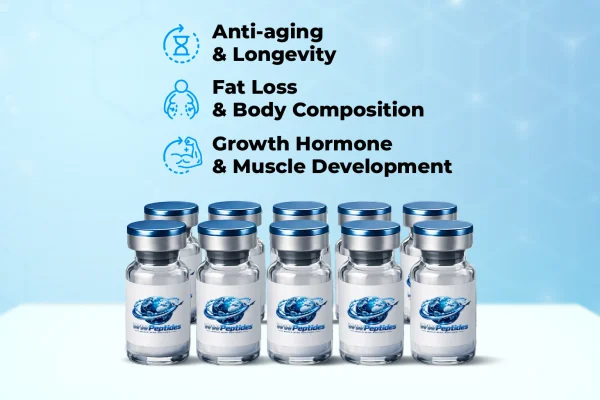
Ipamorelin
Rango de precios: $112.00 a $183.00
Los lotes de Envío directo internacional no se someten a pruebas de terceros antes del despacho. Las pruebas independientes son responsabilidad del cliente. Envíanos cualquier COA y recibe $300 en crédito de tienda. Pedidos del almacén de EE. UU.: hay un COA disponible a solicitud. Envíanos cualquier COA independiente y recibe $300 en crédito de tienda.
-
Garantía de entrega Reenvío gratis si no llega. Excluye Canadá, Brasil y Singapur.
-
Especificación de pureza ≥99% Especificación del fabricante - verificable de forma independiente
-
COA independientes Ver los COA de este producto →
-
Garantía de crédito de tienda Envía cualquier resultado de COA y recibe crédito de tienda
Ipamorelin - Péptido liberador de hormona de crecimiento selectivo
Ipamorelin es un pentapéptido GHRP (péptido liberador de hormona de crecimiento) descrito por primera vez en 1998 como el primer secretagogo de GH verdaderamente sel
Por qué importa la selectividad de Ipamorelin
Los GHRP anteriores provocaban la liberación de GH, pero también estimulaban vías adyacentes - liberación de cortisol, elevación de prolactina y señalización de hambre por desbordamiento de grelina. El diseño estructural de Ipamorelin mantiene el agonismo del receptor de grelina sin la mayor parte de la activación cruzada. Eso lo convierte en la herramienta más limpia para estudios que buscan aislar el efecto del pulso de GH de la señalización GHRP.
| Vía | Qué hace, en términos simples |
|---|---|
| Receptor de grelina (GHS-R1a) | Desencadena un pulso corto de liberación de GH desde la hipófisis |
| Cortisol / ACTH | Elevación mínima - el rasgo distintivo frente a los GHRP anteriores |
| Prolactina | Activación cruzada mínima en la literatura publicada |
| Señalización del apetito | Menos marcado que en los GHRP no sel |
Ipamorelin vs otros GHRP vs péptidos GHRH
La mayor parte de la investigación del eje GH separa los péptidos en GHRP (amplifican el pulso) y análogos de GHRH (inician el pulso). Ipamorelin está en la columna de los GHRP junto con GHRP-2 y GHRP-6; Sermorelin, Tesamorelin y CJC-1295 están en la columna de GHRH.
| Péptido | Clase | Activación cruzada de cortisol / prolactina |
|---|---|---|
| Ipamorelin | GHRP (sel |
Mínimo |
| GHRP-2 | GHRP (no sel |
Moderado |
| GHRP-6 | GHRP (no sel |
Moderado |
| CJC-1295 / Sermorelin | Análogos de GHRH (receptor diferente) | No aplica - vía diferente |
Los investigadores combinan Ipamorelin con un análogo de GHRH (más comúnmente CJC-1295 No DAC, disponible en WWP como mezcla CJC/Ipa en un solo vial) porque ambas vías se amplifican entre sí.
Aplicaciones de investigación
Ipamorelin se utiliza en estudios que examinan:
- Caracterización de la liberación pulsátil de GH
- Investigación de combinaciones GHRH + GHRP (más comúnmente con CJC-1295 No DAC)
- Curvas de respuesta posterior de IGF-1
- Criterios de valoración de composición corporal y recuperación bajo estimulación del eje de GH
- Sel
ectividad comparativa frente a GHRP no sel ectivos (GHRP-2, GHRP-6) - Sueño y alineación del pulso nocturno de GH
Especificaciones
| Formato | Polvo liofilizado |
| Pureza | ≥99% (especificación del fabricante) |
| Alias | Ipa, NNC 26-0161, GHRP sel |
| Tamaños disponibles | 5mg · 10mg |
| Almacenamiento | 2-8°C sin abrir; estable 12+ meses |
| Uso | Solo para fines de investigación - no para uso humano |
Almacenamiento y manejo
Los viales sin abrir se mantienen a 2-8°C en condiciones estándar de cadena de frío y permanecen estables por 12+ meses. Los parámetros de reconstitución, la compatibilidad de solventes y la estabilidad posterior a la reconstitución de Ipamorelin están documentados en la literatura publicada revisada por pares y en las referencias estándar de química de péptidos.
Literatura de referencia
La literatura clínica y preclínica publicada sobre Ipamorelin está disponible en PubMed, Google Scholar y otras bases de datos revisadas por pares. WWP no proporciona diseño de protocolos, orientación de dosificación ni parámetros de administración. Esas decisiones corresponden al investigador y a cualquier comité de revisión institucional aplicable.
Preguntas frecuentes sobre la investigación con Ipamorelin
¿Qué hace Ipamorelin en investigación?
Activa el receptor de grelina en la hipófisis y desencadena un pulso breve de liberación de hormona de crecimiento. Después, esa GH se con
¿Cómo se compara Ipamorelin con Sermorelin?
Actúan mediante receptores distintos. Ipamorelin es un GHRP y apunta al receptor de grelina (amplifica el pulso). Sermorelin es un análogo de GHRH y apunta al receptor de GHRH (inicia el pulso). No son intercambiables - los investigadores suelen combinarlos porque las dos vías funcionan en conjunto.
¿Por qué combinar Ipamorelin con CJC-1295?
CJC-1295 (en especial la versión No DAC, Mod GRF 1-29) inicia un pulso de GH a través del receptor de GHRH; Ipamorelin amplifica ese mismo pulso a través del receptor de grelina. Combinados, producen un pulso más grande y limpio que cualquiera de los dos péptidos por separado - por eso la mezcla CJC/Ipa es la combinación GHRH + GHRP más citada en la investigación publicada.
¿Está Ipamorelin aprobado por la FDA?
No. Ipamorelin no está aprobado por la FDA para ningún uso en humanos. Cada vial que WWP envía está etiquetado y se vende estrictamente para uso exclusivo de laboratorio e investigación.
¿Cómo se almacena Ipamorelin?
Los viales sin abrir se almacenan a 2-8°C y se mantienen estables por más de 12 meses. Una vez reconstituida con agua bacteriostática, la solución se mantiene a 2-8°C y se usa dentro de 28-30 días.
Garantía de pureza
Cada lote se suministra con una especificación de pureza de ≥99%. Envíanos un COA de cualquier prueba independiente y te daremos $300 en crédito de tienda, sin importar lo que muestre.
-
IGF-1 LR3
Rango de precios: $113.00 a $418.00 Seleccionar opciones Este producto tiene varias variantes. Las opciones se pueden elegir en la página del producto -
GHRP-6
Rango de precios: $102.00 a $151.00 Seleccionar opciones Este producto tiene varias variantes. Las opciones se pueden elegir en la página del producto -
Sermorelin
Rango de precios: $164.00 a $300.00 Seleccionar opciones Este producto tiene varias variantes. Las opciones se pueden elegir en la página del producto -
MGF (Mechano-Growth Factor)
$182.00 Seleccionar opciones Este producto tiene varias variantes. Las opciones se pueden elegir en la página del producto