
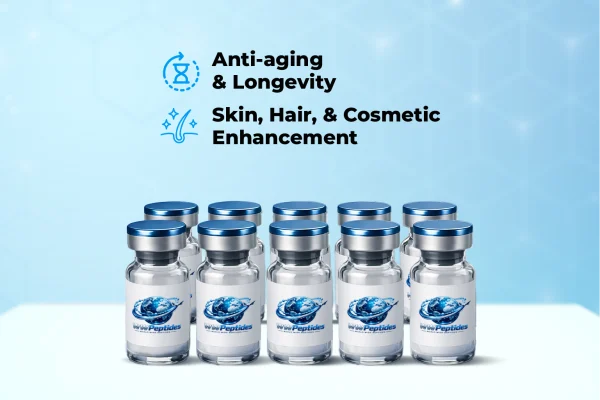
SNAP-8
$112.00
Overseas Direct batches are not third-party tested before dispatch. Independent testing is the customer's responsibility. Send us any COA and receive $300 store credit. US warehouse orders: a COA is available on request. Send us any independent COA and receive $300 store credit.
-
Delivery guarantee Reshipped free if it doesn't arrive. Excludes Canada, Brazil, and Singapore.
-
≥99% purity specification Manufacturer spec - independently verifiable
-
Independent COAs View COAs for this product →
-
Store credit guarantee Send any COA result, get store credit
SNAP-8 - Acetyl Octapeptide-3 Topical Research Peptide
SNAP-8 (acetyl octapeptide-3, also called acetyl glutamyl heptapeptide-1) is a synthetic 8-amino-acid peptide designed to mimic the N-terminus of SNAP-25, a protein component of the SNARE complex that mediates neurotransmitter release at the neuromuscular junction. It was developed specifically as a topical cosmetic research peptide - an extended analog of Argireline (acetyl hexapeptide-3), with two additional residues intended to improve SNARE-complex binding affinity. In research, SNAP-8 is the reference “SNARE-competitive” cosmetic research peptide and is studied almost exclusively in topical formulations targeting expression-line endpoints.
Why the SNAP-25 Mimetic Structure Matters
Muscle contraction requires neurotransmitter release across the neuromuscular junction. That release depends on the SNARE complex - a three-protein assembly (SNAP-25, syntaxin, VAMP) that docks acetylcholine-containing vesicles to the presynaptic membrane. SNAP-8 is engineered to compete with native SNAP-25 for assembly into the complex. When it binds, the complex is incomplete and vesicle docking is impaired. That mechanism is the same axis botulinum toxin targets - but by different means (toxin cleaves SNAP-25; SNAP-8 competes with it). The research distinction is why SNAP-8 shows up in “topical alternative to neuromuscular-blocker” cosmetic research.
| Pathway | What it does in plain terms |
|---|---|
| SNARE complex | Competitive inhibition - SNAP-8 mimics SNAP-25 and disrupts complex assembly |
| Acetylcholine release | Reduced at the neuromuscular junction in published in vitro work |
| Expression-line endpoints | Reduced mimetic-muscle contraction in topical cosmetic research |
| Route of application | Topical - penetration limited by peptide size and formulation vehicle |
SNAP-8 vs Argireline
The two compounds are compared constantly in cosmetic peptide research. SNAP-8 is an extension of the Argireline structure.
| Compound | Structural difference |
|---|---|
| SNAP-8 | 8 amino acids - extended SNAP-25 N-terminus analog |
| Argireline (Acetyl Hexapeptide-3) | 6 amino acids - shorter SNAP-25 N-terminus analog (the parent compound) |
Research Applications
SNAP-8 is used in studies examining:
- SNARE-complex competitive inhibition endpoints
- Topical expression-line cosmetic formulation research
- Acetylcholine-release in vitro research at the neuromuscular junction
- Comparative cosmetic peptide research (SNAP-8 vs Argireline)
- Non-injectable alternative mechanism research vs neuromuscular-blocking toxins
- Peptide penetration and formulation-vehicle research
Specifications
| Format | Lyophilized powder |
| Purity | ≥99% (manufacturer specification) |
| Aliases | SNAP-8, Acetyl Octapeptide-3, Acetyl Glutamyl Heptapeptide-1 |
| Available sizes | 10mg |
| Storage | 2-8°C unopened; stable 12+ months |
| Use | Research purposes only - not for human use |
Storage & Handling
Unopened vials are kept at 2-8°C under standard cold-chain conditions and remain stable for 12+ months. Reconstitution parameters, solvent compatibility, and post-reconstitution stability for SNAP-8 are documented in the published peer-reviewed literature and standard peptide-chemistry references.
Reference Literature
Published clinical and preclinical SNAP-8 literature is available through PubMed, Google Scholar, and other peer-reviewed databases. WWP does not provide protocol design, dosing guidance, or administration parameters. Those decisions rest with the researcher and any applicable institutional review board.
Common Questions About SNAP-8 Research
What is SNAP-8 used for in research?
It is studied as the reference SNARE-complex competitive research peptide. Published work covers topical expression-line cosmetic formulation endpoints, acetylcholine-release in vitro research, and comparative cosmetic peptide research against Argireline.
What is the difference between SNAP-8 and Argireline?
SNAP-8 is an 8-amino-acid extension of Argireline (acetyl hexapeptide-3, 6 amino acids). Both are SNAP-25 N-terminus mimetics that competitively disrupt SNARE-complex assembly. SNAP-8 was designed with two additional residues intended to improve SNARE-complex binding affinity. In cosmetic research literature, SNAP-8 is often marketed as “second-generation Argireline.”
Is SNAP-8 the same mechanism as botulinum toxin?
Both target the SNARE complex, but through different mechanisms. Botulinum toxin is a protease that enzymatically cleaves SNAP-25. SNAP-8 is a small peptide that competes with SNAP-25 for assembly into the SNARE complex. The toxin destroys the protein; the peptide blocks its assembly. Research framing treats them as axis-related but mechanistically distinct.
Is SNAP-8 FDA approved?
No. SNAP-8 is not an FDA-approved drug product. It is an ingredient used in cosmetic research formulations. Every vial WWP ships is labeled and sold strictly for laboratory and research use only.
How is SNAP-8 stored?
Unopened vials are stored at 2-8°C and stay stable for 12+ months. Once reconstituted or incorporated into a topical vehicle, store at 2-8°C and use within 28-30 days.
Purity Guarantee
Every batch is supplied to a ≥99% purity specification. Send us a COA from any independent test and we’ll issue $300 store credit regardless of what it shows.
-

Melanotan 2
$113.00 Select options This product has multiple variants. The options may be chosen on the product page -
Melanotan 1
$113.00 Select options This product has multiple variants. The options may be chosen on the product page -
Glutathione
$214.00 Select options This product has multiple variants. The options may be chosen on the product page -
KLOW Blend (BPC-157 / TB-500 / GHK-Cu / KPV)
Price range: $464.00 through $718.00 Select options This product has multiple variants. The options may be chosen on the product page