
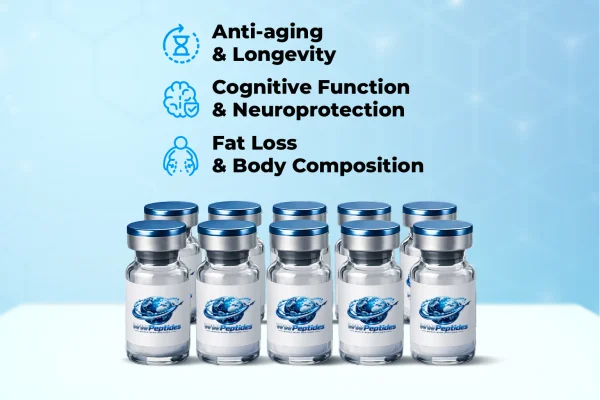
5-ammino-1MQ
$83.00
-
Garanzia di consegna Rispedizione gratuita in caso di mancata consegna
-
Purezza ≥99% Produzione diretta dal produttore
-
Certificati di analisi indipendenti Visualizza i COA per questo prodotto →
-
Garanzia di credito negozio Invia qualsiasi risultato COA e ricevi un credito negozio
5-Amino-1MQ - Selective NNMT Inhibitor Research Compound
5-Amino-1MQ (5-amino-1-methylquinolinium) is a small-molecule sel
Why NNMT Inhibition Matters
NNMT methylates nicotinamide (NAM) to form 1-methylnicotinamide (MNA), using S-adenosylmethionine (SAM) as the methyl donor. The reaction sinks both NAM and SAM - two metabolically central substrates. In adipose tissue, elevated NNMT activity correlates with obesity and insulin resistance. Blocking NNMT with 5-Amino-1MQ preserves the NAM pool (feeds back into NAD+ salvage) and spares SAM (improves methylation flux elsewhere). That is the mechanistic rationale behind the published adipose-tissue and body-composition research on the compound.
| Percorso | In parole povere, ecco cosa fa |
|---|---|
| NNMT enzyme | Inhibited - nicotinamide no longer methylated and excreted |
| NAD+ salvage pathway | Preserved NAM feeds back into NAD+ recycling |
| SAM / methyl-donor pool | Spared - not consumed by the NNMT reaction |
| Adipocyte energy expenditure | Increased lipolysis reported in published in-vitro and rodent work |
5-Amino-1MQ vs NAD+ / NR / NMN
All four compounds influence the NAD+ pool, but they act at different points in the pathway.
| Composto | Mechanism |
|---|---|
| 5-ammino-1MQ | Inhibits NNMT - blocks NAM excretion, preserves NAD+ precursor pool |
| NAD+ (direct) | Supplies the cofactor directly - bypasses salvage pathway |
| NR (nicotinamide riboside) | Precursor - enters the salvage pathway one step upstream of NAD+ |
| NMN (nicotinamide mononucleotide) | Precursor - enters the salvage pathway two steps upstream of NAD+ |
5-Amino-1MQ is unique among them because it does not supply any precursor - it blocks the enzyme that drains the pool.
Applicazioni di ricerca
5-Amino-1MQ is used in studies examining:
- NNMT activity and sel
ective enzyme inhibition - NAD+ / NAM pool regulation and salvage-pathway flux
- Adipose-tissue metabolism and lipolysis endpoints
- SAM / methyl-donor pool research
- Insulin-sensitivity and body-composition models
- Comparative research vs. NAD+, NR, and NMN
Specifiche tecniche
| Formato | Polvere liofilizzata |
| Purezza | ≥99% |
| Alias | 5-Amino-1-methylquinolinium iodide, 5A1MQ, NNMT inhibitor |
| Molecular class | Small molecule (not a peptide) |
| Archiviazione | 2-8 °C se non aperto; stabile per oltre 12 mesi |
| Utilizzo | Research purposes only - not for human use |
Storage & Handling
Unopened vials are kept at 2-8°C under standard cold-chain conditions and remain stable for 12+ months. Reconstitution parameters, solvent compatibility, and post-reconstitution stability for 5-Amino-1MQ are documented in the published peer-reviewed literature and standard peptide-chemistry references.
Reference Literature
Published clinical and preclinical 5-Amino-1MQ literature is available through PubMed, Google Scholar, and other peer-reviewed databases. WWP does not provide protocol design, dosing guidance, or administration parameters. Those decisions rest with the researcher and any applicable institutional review board.
Common Questions About 5-Amino-1MQ Research
What does 5-Amino-1MQ do in research?
It sel
What is the difference between 5-Amino-1MQ and NAD+?
They influence the same NAD+ pool from opposite directions. NAD+ supplies the cofactor directly; 5-Amino-1MQ inhibits the enzyme that drains the precursor pool. NR and NMN are precursors that feed the salvage pathway. Combination research exists because the mechanisms are complementary rather than redundant.
Is 5-Amino-1MQ a peptide?
No. 5-Amino-1MQ is a small-molecule quinolinium derivative, not a peptide. It is the only non-peptide research compound in most “peptide” research catalogs, and it is included because its NAD+/NNMT research axis overlaps heavily with peptide-adjacent longevity and body-composition literature.
Is 5-Amino-1MQ FDA approved?
No. 5-Amino-1MQ is not FDA approved for any use. It is a research compound only. Every vial WWP ships is labeled and sold strictly for laboratory and research use only.
How is 5-Amino-1MQ stored?
Le fiale non aperte vanno conservate a una temperatura compresa tra 2 e 8 °C e mantengono la loro stabilità per oltre 12 mesi. Una volta ricostituita con acqua batteriostatica, la soluzione va conservata a una temperatura compresa tra 2 e 8 °C e utilizzata entro 28-30 giorni.
Garanzia di purezza
Ogni lotto ha una purezza pari o superiore al 99%. Inviateci un certificato di analisi (COA) redatto da un ente indipendente e vi accrediteremo un buono acquisto indipendentemente dai risultati riportati.
-
WWP-1X (Sema)
Price range: $87.00 through $188.00 Seleziona le opzioni Questo prodotto è disponibile in diverse varianti. Le opzioni possono essere selezionate nella pagina del prodotto -
MOTS-c
Price range: $131.00 through $384.00 Seleziona le opzioni Questo prodotto è disponibile in diverse varianti. Le opzioni possono essere selezionate nella pagina del prodotto -
WWP-3X (Reta)
Price range: $220.00 through $952.00 Seleziona le opzioni Questo prodotto è disponibile in diverse varianti. Le opzioni possono essere selezionate nella pagina del prodotto -
WWP-5X (Cagri)
Price range: $197.00 through $308.00 Seleziona le opzioni Questo prodotto è disponibile in diverse varianti. Le opzioni possono essere selezionate nella pagina del prodotto