
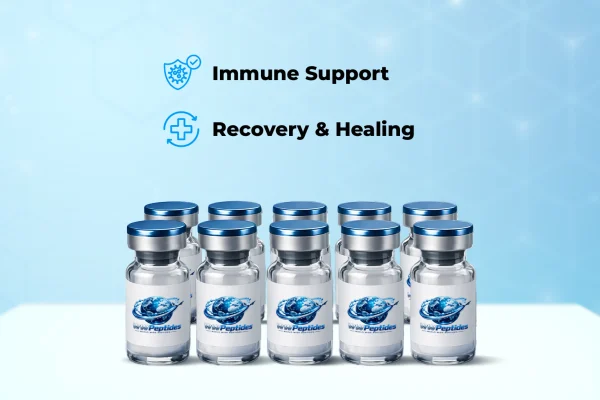
LL-37
$229.00
Los lotes de Envío directo internacional no se someten a pruebas de terceros antes del despacho. Las pruebas independientes son responsabilidad del cliente. Envíanos cualquier COA y recibe $300 en crédito de tienda. Pedidos del almacén de EE. UU.: hay un COA disponible a solicitud. Envíanos cualquier COA independiente y recibe $300 en crédito de tienda.
-
Garantía de entrega Reenvío gratis si no llega. Excluye Canadá, Brasil y Singapur.
-
Especificación de pureza ≥99% Especificación del fabricante - verificable de forma independiente
-
COA independientes Ver los COA de este producto →
-
Garantía de crédito de tienda Envía cualquier resultado de COA y recibe crédito de tienda
LL-37 - Péptido antimicrobiano catelicidina humano
LL-37 es el fragmento C-terminal activo de 37 aminoácidos de hCAP-18, el único péptido catelicidina presente en humanos. Lo liberan los neutrófilos, las células epiteliales y la piel en respuesta a infecciones y lesiones, y es objeto de una literatura amplia y activa sobre defensa antimicrobiana, inmunomodulación y reparación tisular. A diferencia de los antibióticos de espectro reducido, LL-37 es un péptido de inmunidad innata de amplio espectro - interactúa con membranas bacterianas, envolturas virales y células inmunitarias del huésped sobre la misma estructura.
Por qué importa el perfil dual de LL-37
LL-37 se estudia por dos actividades distintas a la vez: un efecto antimicrobiano directo (altera las membranas bacterianas y virales) y un efecto inmunomodulador (recluta y activa células inmunitarias, y se une al LPS para atenuar la señalización de endotoxinas). La mayoría de los péptidos de investigación se ubican en un eje o en el otro. LL-37 se ubica en ambos - por eso aparece a la vez en la literatura de antimicrobianos, cicatrización de heridas e inmunología.
| Vía | Qué hace, en términos simples |
|---|---|
| Membranas bacterianas | Altera las bicapas lipídicas - acción antimicrobiana directa de amplio espectro |
| Unión a LPS | Neutraliza la endotoxina y atenúa la señalización inflamatoria posterior |
| Reclutamiento de células inmunitarias | Quimiotáctico para neutrófilos, monocitos y células T |
| Señalización en el sitio de la herida | Citado en la literatura sobre reepitelización y angiogénesis |
LL-37 vs KPV
LL-37 y KPV aparecen juntos en algunos diseños de estudio antiinfecciosos y antiinflamatorios, así que vale la pena señalar la diferencia.
| Péptido | Tamaño | Vía principal |
|---|---|---|
| LL-37 | 37 aminoácidos | Antimicrobiano directo + inmunomodulador (familia de las catelicidinas) |
| KPV | 3 aminoácidos | Solo antiinflamatorio (fragmento C-terminal de alfa-MSH) |
Aplicaciones de investigación
LL-37 se utiliza en estudios que examinan:
- Actividad antimicrobiana de amplio espectro - modelos bacterianos, virales y de biopelículas
- Unión y neutralización de endotoxinas (LPS)
- Cicatrización de heridas y reepitelización
- Quimiotaxis y activación de neutrófilos y monocitos
- Señalización inmunitaria de la barrera cutánea relevante para la psoriasis
- Trabajos de relación estructura-actividad de la familia de las catelicidinas
Especificaciones
| Formato | Polvo liofilizado |
| Pureza | ≥99% (especificación del fabricante) |
| Alias | Catelicidina, fragmento C-terminal de hCAP-18, péptido antimicrobiano humano LL-37 |
| Tamaños disponibles | 5mg |
| Almacenamiento | 2-8°C sin abrir; estable 12+ meses |
| Uso | Solo para fines de investigación - no para uso humano |
Almacenamiento y manejo
Los viales sin abrir se mantienen a 2-8°C en condiciones estándar de cadena de frío y permanecen estables por 12+ meses. Los parámetros de reconstitución, la compatibilidad de solventes y la estabilidad posterior a la reconstitución de LL-37 están documentados en la literatura publicada revisada por pares y en las referencias estándar de química de péptidos.
Literatura de referencia
La literatura clínica y preclínica publicada sobre LL-37 está disponible en PubMed, Google Scholar y otras bases de datos revisadas por pares. WWP no proporciona diseño de protocolos, orientación de dosificación ni parámetros de administración. Esas decisiones corresponden al investigador y a cualquier comité de revisión institucional aplicable.
Preguntas frecuentes sobre la investigación con LL-37
¿Qué hace LL-37 en investigación?
Se estudia con mayor frecuencia como péptido de defensa del huésped con dos actividades paralelas: acción antimicrobiana directa contra bacterias, virus y biopelículas, y efectos inmunomoduladores que incluyen unión a LPS, reclutamiento de células inmunitarias y señalización de cicatrización de heridas.
¿Cuál es la diferencia entre LL-37 y KPV?
LL-37 es una catelicidina de 37 aminoácidos con actividad antimicrobiana directa e inmunomoduladora. KPV es un fragmento de alfa-MSH de 3 aminoácidos con actividad solo antiinflamatoria y sin perfil antimicrobiano directo. A veces se combinan en diseños de estudio donde se miden criterios de valoración tanto antimicrobianos como antiinflamatorios.
¿En qué enfermedades se estudia LL-37?
La investigación publicada abarca modelos de infección bacteriana y viral, modelos de heridas crónicas y úlceras diabéticas, investigación sobre psoriasis y barrera cutánea, modelos de inflamación intestinal y trabajos de biología del cáncer que examinan la expresión de catelicidina. LL-37 es un péptido en etapa de descubrimiento - no es un terapéutico aprobado.
¿Está LL-37 aprobado por la FDA?
No. LL-37 no está aprobado por la FDA para ningún uso en humanos. Cada vial que WWP envía está etiquetado y se vende estrictamente para uso exclusivo de laboratorio e investigación.
¿Cómo se almacena LL-37?
Los viales sin abrir se almacenan a 2-8°C y se mantienen estables por más de 12 meses. Una vez reconstituida con agua bacteriostática, la solución se mantiene a 2-8°C y se usa dentro de 28-30 días.
Garantía de pureza
Cada lote se suministra con una especificación de pureza de ≥99%. Envíanos un COA de cualquier prueba independiente y te daremos $300 en crédito de tienda, sin importar lo que muestre.
-

BPC-157
Rango de precios: $90.00 a $275.00 Seleccionar opciones Este producto tiene varias variantes. Las opciones se pueden elegir en la página del producto -

TB-500
Rango de precios: $184.00 a $345.00 Seleccionar opciones Este producto tiene varias variantes. Las opciones se pueden elegir en la página del producto -

BPC-157 / TB-500
Rango de precios: $232.00 a $538.00 Seleccionar opciones Este producto tiene varias variantes. Las opciones se pueden elegir en la página del producto -

DSIP
Rango de precios: $113.00 a $173.00 Seleccionar opciones Este producto tiene varias variantes. Las opciones se pueden elegir en la página del producto