
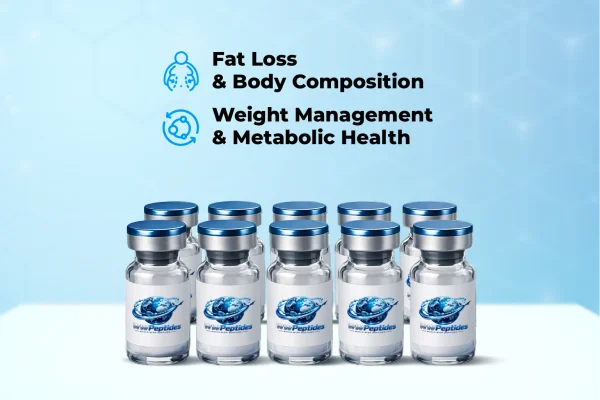
Cagrilintide
Price range: $197.00 through $307.00
-
Delivery guarantee Reshipped free if it doesn't arrive
-
≥99% purity Manufacturer-direct production
-
Independent COAs View COAs for this product →
-
Store credit guarantee Send any COA result, get store credit
Cagrilintide - Long-Acting Amylin Analog Research Peptide
Cagrilintide is a synthetic long-acting analog of amylin, a hormone co-released with insulin from pancreatic beta cells after a meal. It was developed by Novo Nordisk (the company behind Ozempic and Wegovy) and is most often studied alongside semaglutide in the investigational combination known as CagriSema. Amylin sits on a different signaling pathway than GLP-1, which is why researchers pair the two: combined, they address hunger and satiety through non-overlapping mechanisms. Cagrilintide on its own is the single-peptide research tool for characterizing amylin-receptor effects.
Why Amylin Matters
GLP-1 peptides (semaglutide, tirzepatide) act through the incretin system - they amplify insulin release and slow gastric emptying in response to glucose. Amylin is a parallel hormone that acts on different receptors in the brainstem and hypothalamus to regulate meal size, food reward, and satiety. Native human amylin is fast-degrading and tends to aggregate, so researchers use cagrilintide (a stabilized analog with a fatty-acid side chain similar to semaglutide’s) as the research tool.
| Site of action | What it does in plain terms |
|---|---|
| Amylin receptors (brainstem) | Regulates meal-size and satiety signals that are distinct from GLP-1 |
| Stomach | Slows gastric emptying |
| Pancreas | Suppresses post-meal glucagon |
Cagrilintide vs Semaglutide vs CagriSema
These three show up together in most cagrilintide research, so the distinction matters.
| Compound | Mechanism class | Frequency |
|---|---|---|
| Cagrilintide | Amylin analog (single mechanism) | Once weekly |
| Semaglutide | GLP-1 agonist (single mechanism) | Once weekly |
| CagriSema | Amylin + GLP-1 paired | Once weekly, co-formulated |
Cagrilintide and semaglutide act on non-overlapping pathways, which is the mechanistic basis for pairing them. CagriSema (Cagrilintide / Semaglutide) is the co-formulated research blend, also available from WWP.
Research Applications
Cagrilintide is used in studies examining:
- Amylin-receptor signaling in isolation from GLP-1 effects
- Body-composition changes under sustained amylin agonism
- Meal-size and satiety modeling
- Gastric-emptying dynamics separate from incretin effects
- Combination study designs with GLP-1 peptides (CagriSema framework)
- Dose-response curves across the published 0.16-4.5mg range
Specifications
| Format | Lyophilized powder |
| Purity | ≥99% |
| Aliases | NN9838, AM833, long-acting amylin analog |
| Available sizes | 5mg · 10mg |
| Storage | 2-8°C unopened; stable 12+ months |
| Use | Research purposes only - not for human use |
Storage & Handling
Unopened vials are kept at 2-8°C under standard cold-chain conditions and remain stable for 12+ months. Reconstitution parameters, solvent compatibility, and post-reconstitution stability for Cagrilintide are documented in the published peer-reviewed literature and standard peptide-chemistry references.
Reference Literature
Published clinical and preclinical Cagrilintide literature is available through PubMed, Google Scholar, and other peer-reviewed databases. WWP does not provide protocol design, dosing guidance, or administration parameters. Those decisions rest with the researcher and any applicable institutional review board.
Common Questions About Cagrilintide Research
Is cagrilintide better than semaglutide?
They are not direct substitutes - they act on different receptor systems. Semaglutide is a GLP-1 agonist; cagrilintide is an amylin analog. Researchers don’t replace one with the other; they pair them (see CagriSema). In monotherapy trials, semaglutide has produced larger body-composition endpoints than cagrilintide alone.
What is the difference between cagrilintide and tirzepatide?
Cagrilintide targets the amylin receptor system; tirzepatide targets GLP-1 and GIP. They are studied in different research contexts. A cross-mechanism combination (cagrilintide + tirzepatide) has been examined in research literature and is the subject of ongoing Novo Nordisk and Eli Lilly work.
What does cagrilintide do in metabolic studies?
It activates amylin receptors in the brainstem and hypothalamus, reducing meal size and delaying gastric emptying. Most commonly tracked endpoints are ad-libitum caloric intake, body composition, and glycemic markers.
Is cagrilintide FDA approved?
No. Cagrilintide is still in Phase 3 clinical trials, most visibly as the CagriSema combination. It is not approved by the FDA for any use. Every vial WWP ships is labeled and sold strictly for laboratory and research use only.
How is cagrilintide stored?
Unopened vials are stored at 2-8°C and stay stable for 12+ months. Once reconstituted with bacteriostatic water, the solution is kept at 2-8°C and used within 28-30 days.
Purity Guarantee
Every batch is ≥99% purity. Send us a COA from any independent test and we’ll issue store credit regardless of what it shows.
-

GHRP-6
Price range: $97.00 through $141.00 Select options This product has multiple variants. The options may be chosen on the product page -
Lipo-C
$154.00 Select options This product has multiple variants. The options may be chosen on the product page -
Cagrilintide / Semaglutide
$650.00 Select options This product has multiple variants. The options may be chosen on the product page -

MGF (Mechano-Growth Factor)
$173.00 Select options This product has multiple variants. The options may be chosen on the product page