

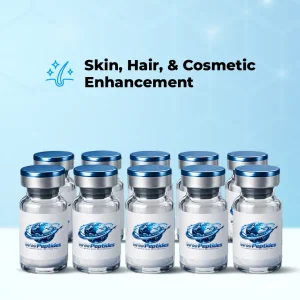
GLOW (BPC-157 / TB-4 / GHK-Cu)
Price range: $407.00 through $577.00
-
Garanzia di consegna Rispedizione gratuita in caso di mancata consegna
-
Purezza ≥99% Produzione diretta dal produttore
-
Certificati di analisi indipendenti Visualizza i COA per questo prodotto →
-
Garanzia di credito negozio Invia qualsiasi risultato COA e ricevi un credito negozio
GLOW Peptide Blend - BPC-157 + TB-500 + GHK-Cu Research Stack
GLOW is a three-peptide blend in a single vial: BPC-157, TB-500 (Thymosin Beta-4 fragment), and GHK-Cu. Each of the three is well-studied on its own, and each is studied in a different stage of tissue-repair research - BPC-157 in early vascular and cell-migration signaling, TB-500 in cell-motility and systemic models, and GHK-Cu in later-structural rebuild (collagen, matrix, skin quality). Combining them in one vial is convenient for research models that want to look at all three stages of repair at once instead of one at a time.
Why a Three-Peptide Blend
Healing is not a single event - it is a sequence. Blood vessels have to grow, new cells have to migrate into the wound, and then collagen has to lay down structure. Each peptide in GLOW sits on a different part of that timeline, and they don’t duplicate each other’s jobs.
| Componente | In parole povere, ecco cosa fa | Stage |
|---|---|---|
| BPC-157 | Triggers new blood vessels, starts repair at the injury site | Early |
| TB-500 | Keeps cells moving into the wound, calms inflammation system-wide | Middle |
| GHK-Cu | Builds collagen and structural tissue, supports skin quality | Late |
GLOW vs KLOW - How the Two Blends Differ
GLOW and KLOW are both multi-peptide research blends, but they are built for different endpoints. GLOW is the three-peptide repair blend (BPC-157 / TB-500 / GHK-Cu). KLOW adds a fourth peptide - KPV - for an anti-inflammatory and mucosal repair angle on top of the standard repair stack.
| Blend | Components | Research focus |
|---|---|---|
| GLOW | BPC-157 + TB-500 + GHK-Cu | Tissue repair across all three stages (vascular / cellular / structural) |
| KLOW | BPC-157 + TB-500 + GHK-Cu + KPV | Same repair focus plus mucosal and anti-inflammatory support |
Applicazioni di ricerca
GLOW is used in studies examining:
- Wound healing across all three stages in one model
- Tendon, ligament, and muscle recovery after injury
- Skin quality and scar formation research
- Inflammation reduction using three overlapping mechanisms
- Blood vessel repair where multiple pathways matter
- Age-related tissue decline (GHK-Cu naturally drops with age)
- Comparing single-peptide vs. blended protocols in the same model
Specifiche tecniche
| Blend composition | BPC-157 10mg / TB-500 10mg / GHK-Cu 50mg |
| Total vial content | 70mg lyophilized powder |
| Formato | Lyophilized powder, filler-free |
| Purezza | ≥99% per component |
| Alias | GLOW, BPC/TB/GHK Stack |
| Taglie disponibili | 50mg · 70mg |
| Archiviazione | 2-8°C unopened; protect from light |
| Utilizzo | Research purposes only - not for human use |
Storage & Handling
Unopened vials are kept at 2-8°C under standard cold-chain conditions and remain stable for 12+ months. Reconstitution parameters, solvent compatibility, and post-reconstitution stability for GLOW (BPC-157 / TB-4 / GHK-Cu) are documented in the published peer-reviewed literature and standard peptide-chemistry references.
Reference Literature
Published clinical and preclinical GLOW (BPC-157 / TB-4 / GHK-Cu) literature is available through PubMed, Google Scholar, and other peer-reviewed databases. WWP does not provide protocol design, dosing guidance, or administration parameters. Those decisions rest with the researcher and any applicable institutional review board.
Common Questions About GLOW Peptide Research
What is GLOW peptide used for in research?
GLOW is used in research models where more than one stage of tissue repair is the endpoint. Because it combines an early-stage peptide (BPC-157), a mid-stage peptide (TB-500), and a late-stage peptide (GHK-Cu) in a fixed ratio, it is useful for wound-healing, soft-tissue repair, skin quality, and anti-aging research where the researcher wants to look at vascular, cellular, and structural recovery in a single study arm.
What is the difference between GLOW and KLOW peptide blends?
GLOW contains three peptides: BPC-157, TB-500, and GHK-Cu. KLOW is the same three plus a fourth - KPV, an anti-inflammatory tripeptide studied at mucosal surfaces. Researchers choose GLOW when the focus is pure tissue repair; KLOW when they also want to look at inflammation or gut-related endpoints.
How is GLOW typically referenced in published research?
GLOW combines BPC-157, TB-500, and GHK-Cu in a fixed ratio. Researchers designing studies involving GLOW or its individual components can find published clinical and preclinical literature through PubMed and other peer-reviewed databases. WWP does not provide protocol design, dosing guidance, or administration parameters.
Why does the reconstituted solution look pale blue?
That’s the GHK-Cu copper chelate - one of the three peptides in the blend is bound to a copper atom, which gives the solution a characteristic clear-to-pale-blue color. It is expected and indicates the peptide is intact. Cloudiness, particulates, or unusual color change would indicate degradation; a clear blue tint is normal.
How is GLOW stored?
Unopened lyophilized vials are stored at 2-8°C and protected from light. Once reconstituted, the solution is kept at 2-8°C and used within 28 days. GHK-Cu is the least stable component post-reconstitution, so the 28-day window should not be extended. Do not refreeze the reconstituted solution.
Research Stacks
GLOW is commonly paired in research settings with:
- Additional BPC-157 - When a study wants more BPC-157 than the fixed ratio in the blend provides.
- Additional TB-500 - For research models that need higher TB-500 exposure than the blend delivers.
- Additional GHK-Cu - For skin and collagen-focused work where GHK-Cu is the primary variable.
Garanzia di purezza
Ogni lotto ha una purezza pari o superiore al 99%. Inviateci un certificato di analisi (COA) redatto da un ente indipendente e vi accrediteremo un buono acquisto indipendentemente dai risultati riportati.
-

Timosina alfa-1
Price range: $218.00 through $394.00 Seleziona le opzioni Questo prodotto è disponibile in diverse varianti. Le opzioni possono essere selezionate nella pagina del prodotto -
Melanotan 1
$108.00 Seleziona le opzioni Questo prodotto è disponibile in diverse varianti. Le opzioni possono essere selezionate nella pagina del prodotto -

KPV
Price range: $94.00 through $146.00 Seleziona le opzioni Questo prodotto è disponibile in diverse varianti. Le opzioni possono essere selezionate nella pagina del prodotto -

BPC-157 / TB-500
Price range: $221.00 through $512.00 Seleziona le opzioni Questo prodotto è disponibile in diverse varianti. Le opzioni possono essere selezionate nella pagina del prodotto