
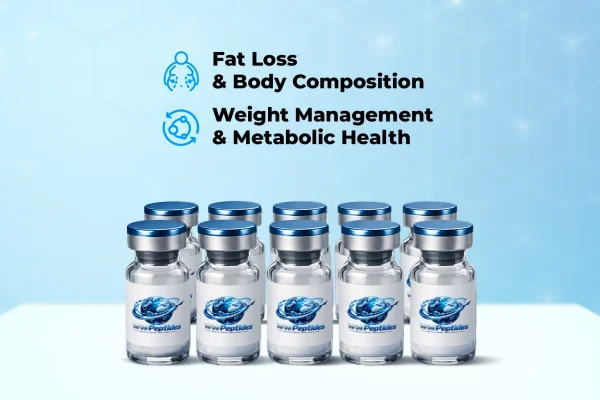
Lipo-C
$162.00
Overseas Direct batches are not third-party tested before dispatch. Independent testing is the customer's responsibility. Send us any COA and receive $300 store credit. US warehouse orders: a COA is available on request. Send us any independent COA and receive $300 store credit.
-
Delivery guarantee Reshipped free if it doesn't arrive. Excludes Canada, Brazil, and Singapore.
-
≥99% purity specification Manufacturer spec - independently verifiable
-
Independent COAs View COAs for this product →
-
Store credit guarantee Send any COA result, get store credit
Lipo-C - Methionine / Inositol / Choline Lipotropic Blend Research Compound
Lipo-C is a compounded “lipotropic” injection that combines methionine, inositol, and choline (the MIC triad) with a supporting B-vitamin stack. It is not a peptide and not a single molecule - it is a multi-component preparation studied for its role in hepatic lipid metabolism and methyl-group transfer. In the research-compound toolkit, Lipo-C is the reference MIC preparation: methionine supplies the sulfur-containing amino acid for methyl donation, inositol supports membrane phosphoinositide signaling, and choline is the substrate for phosphatidylcholine and acetylcholine synthesis.
Why the MIC Triad Matters
Hepatic lipid export relies on phosphatidylcholine synthesis and on adequate methyl-group supply to support the methionine / S-adenosylmethionine (SAM) cycle. Choline deficiency is one of the fastest ways to induce hepatic steatosis in animal models. The MIC triad supplies all three substrates in a single preparation - which is the specific research framing of Lipo-C. The added B-vitamins (B-complex, B12, sometimes carnitine in extended formulations) are cofactors for the one-carbon-transfer and fatty-acid-transport enzymes that the triad feeds.
| Component | Role in the research profile |
|---|---|
| Methionine | Sulfur amino acid - feeds SAM cycle for methyl-group transfer |
| Inositol | Phosphoinositide membrane-signaling substrate |
| Choline | Phosphatidylcholine synthesis - required for hepatic VLDL export |
| B-vitamin cofactors | Support one-carbon metabolism and fatty-acid transport enzymes |
Research Applications
Lipo-C is used in studies examining:
- Hepatic lipid metabolism and phosphatidylcholine-dependent VLDL export
- Methyl-group transfer and SAM-cycle flux research
- Choline-deficiency hepatic-steatosis models
- One-carbon metabolism and B-vitamin cofactor research
- Body-composition endpoints in compounded multi-vitamin protocols
- Comparative research vs pure choline or pure B12 preparations
Specifications
| Format | Sterile aqueous solution |
| Composition | Methionine + Inositol + Choline + B-complex vitamins |
| Aliases | Lipo C, MIC injection, MIC-B, lipotropic injection |
| Available sizes | 10mL multi-dose vial |
| Storage | 2-8°C protected from light; stable 12+ months |
| Use | Research purposes only - not for human use |
Storage & Handling
Lipo-C ships as a sterile solution rather than as a lyophilized powder. Unopened vials are kept at 2-8°C under standard cold-chain conditions and protected from light. Handling and stability parameters for Lipo-C are documented in the published peer-reviewed literature.
Reference Literature
Published clinical and preclinical Lipo-C literature is available through PubMed, Google Scholar, and other peer-reviewed databases. WWP does not provide protocol design, dosing guidance, or administration parameters. Those decisions rest with the researcher and any applicable institutional review board.
Common Questions About Lipo-C Research
What is Lipo-C used for in research?
It is studied as the reference MIC (methionine / inositol / choline) lipotropic preparation. Published work covers hepatic phosphatidylcholine synthesis, SAM-cycle methyl-group transfer, choline-deficiency hepatic steatosis models, and one-carbon metabolism endpoints.
Is Lipo-C a peptide?
No. Lipo-C is a multi-component preparation of amino acids, inositol, choline, and B-vitamins - it is not a peptide. It appears in the research-compound toolkit because its metabolic research axis overlaps heavily with peptide-adjacent body-composition and hepatic-function literature.
What is the difference between Lipo-C and a plain B12 injection?
B12 is a single cofactor. Lipo-C is a combined MIC + B-complex preparation. B12 supports the methionine/SAM cycle by acting as a cofactor for methionine synthase; Lipo-C supplies the methionine substrate itself plus choline and inositol. The research framings are different - B12 research focuses on cobalamin status; Lipo-C research focuses on combined lipotropic-pathway flux.
Is Lipo-C FDA approved?
No. Lipo-C is a compounded preparation, not an FDA-approved drug product. Individual components (methionine, choline, B-vitamins) are widely available as separate supplements or compounded ingredients, but the combination is not an approved pharmaceutical. Every vial WWP ships is labeled and sold strictly for laboratory and research use only.
How is Lipo-C stored?
Unopened vials are kept at 2-8°C under standard cold-chain conditions, protected from light. Stability and handling parameters for Lipo-C are documented in the published peer-reviewed literature.
Purity Guarantee
Every batch is supplied to a ≥99% purity specification. Send us a COA from any independent test and we’ll issue $300 store credit regardless of what it shows.
-

MOTS-c
Price range: $138.00 through $403.00 Select options This product has multiple variants. The options may be chosen on the product page -
WWP-1X (Sema)
Price range: $91.00 through $197.00 Select options This product has multiple variants. The options may be chosen on the product page -
SLU-PP-332
$229.00 Select options This product has multiple variants. The options may be chosen on the product page -
WWP-4X (Survo)
$543.00 Select options This product has multiple variants. The options may be chosen on the product page